
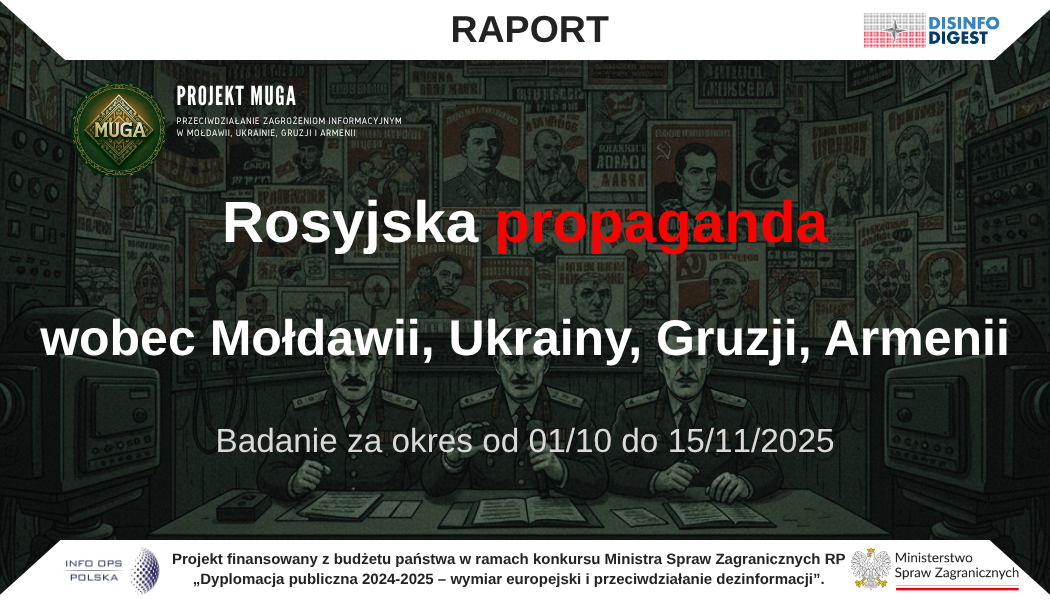



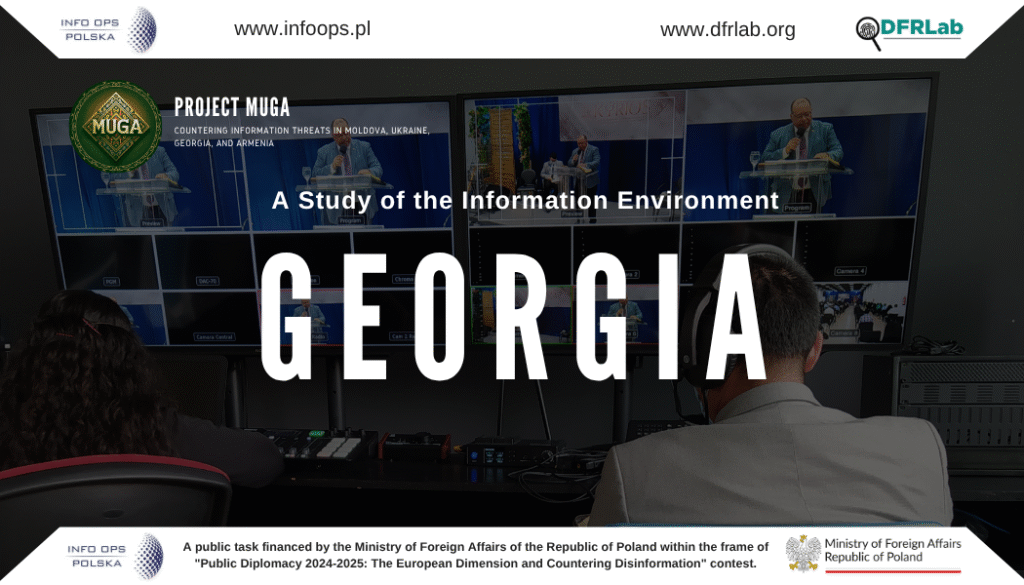
This report is the result of Project MUGA, implemented by the INFO OPS Polska Foundation and DFRLab (Atlantic Council), which aimed to conduct a comprehensive analysis of Georgia’s information environment. The geopolitical situation in the South Caucasus region, particularly the intensification of disinformation activities, served as the starting point for a multifaceted investigation and assessment of the primary threats related to information manipulation, the discrediting of Georgia’s pro-Western aspirations, and the maintenance of Kremlin influence in the country.
The report is divided into several key sections, ranging from a characterization and description of available information sources (both traditional and digital), through an analysis of the role of religious institutions and civil society organizations, to the specific identification and description of selected manipulation techniques. A separate chapter is dedicated to organized disinformation activities targeting Western countries, including Poland. We also detail the operational mechanisms of pro-Russian organizations and media in Georgia, presenting examples of anti-Western narratives and propaganda practices that threaten the country’s internal stability.
The report considers both the historical context and current political events, illustrating the scale of influence exerted by external forces and local actors on public consciousness in Georgia. The case studies presented herein (including an analysis of narratives targeting Poland and the protests in Georgia) shed light on the practical aspects of how these narratives function in the public sphere. The report concludes with a set of recommendations and guidelines, taking into account Poland’s strategic needs in the region, the outlook for future developments in Georgia, and the necessity of implementing preventive measures.
The evidence presented in the report demonstrates that processes linked to the intensification of Russian influence are taking place in Georgia. These are manifested in a complex disinformation and propaganda campaign aimed at undermining trust in public institutions, Western allies, and the values promoted by the international community. There is also significant evidence of attempts to introduce new political forces or “pseudo-patriotic” organizations seeking to build alternative, anti-Western narratives.
The report’s conclusions do not focus solely on diagnosing threats but also identify potential avenues for counteraction. These include, inter alia, media literacy, strengthening independent media, monitoring the information space, and coordinating efforts at the international level. It should be emphasized that such actions are necessary to maintain Georgia’s political stability and security, as well as to reinforce its pro-Western aspirations.
The report is financed from the state budget within the framework of the grant competition of the Minister of Foreign Affairs of the Republic of Poland: “Public Diplomacy 2024-2025 – European dimension and countering disinformation.”
The publication expresses the views of the author solely and cannot be equated with the official position of the Ministry of Foreign Affairs of the Republic of Poland.